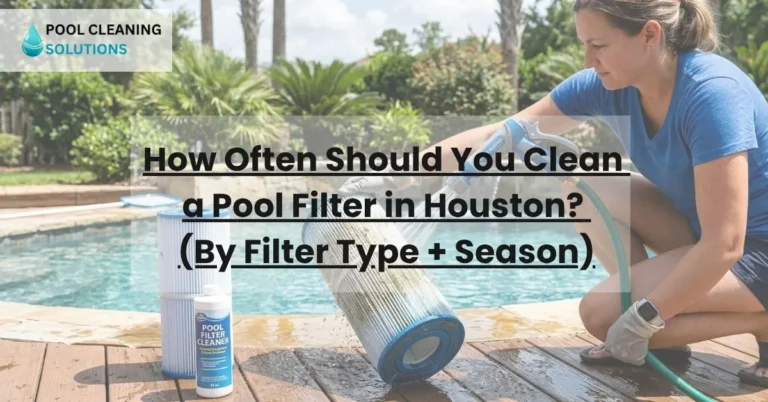
Pool filter cleaning in Houston means removing trapped debris, oils, and contaminants from your sand, cartridge, or DE filter to restore proper water flow and keep your pool safe. Houston’s heat, heavy pollen, and frequent storms force filters to work harder than in most U.S. cities. Cleaning your filter every 3–6 weeks during swim season prevents cloudy water, equipment damage, and costly repairs.
Why Does Your Pool Filter Get Dirty Faster in Houston Than Other Cities?
Houston’s climate is brutal on pool filters. Temperatures regularly hit 95°F+ from May through September, and humidity stays above 70% almost year-round.
High heat accelerates algae growth. Heavy rainfall dilutes your chemicals and dumps organic matter straight into your pool. Oak pollen season (February–April) can clog a cartridge filter in days.
Houston also sits in a subtropical zone. That means you swim more months of the year, which means your filter runs longer and fills up faster than pools in cooler states.
Houston pools need filter cleaning 30–50% more often than the national average schedule.
What Are the Three Types of Pool Filters Houston Homeowners Use?
Knowing your filter type is the first step. Each one cleans differently and needs a different maintenance approach.
| Filter Type | How It Works | Filtration Size | Best For |
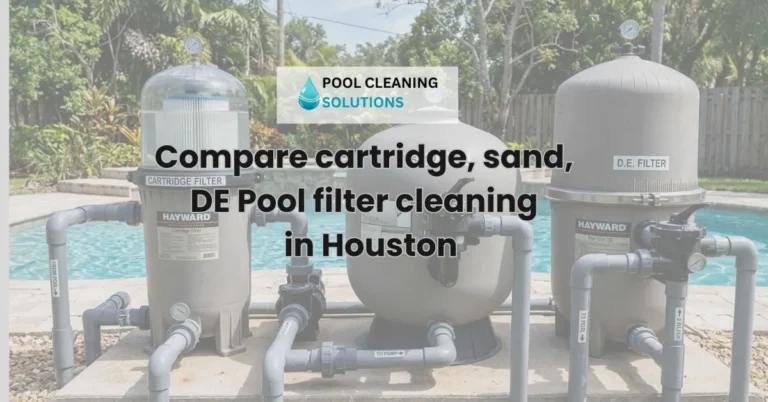
| Cartridge | Pleated polyester traps debris | 10–15 microns | Most Houston residential pools |
| Sand | Water flows through graded sand | 20–40 microns | Budget-conscious owners, heavy debris |
| DE (Diatomaceous Earth) | DE powder coats internal grids | 1–5 microns | Best water clarity, high pollen areas |
Cartridge filters are the most common in Houston neighborhoods. They require no backwashing and handle fine dust well, which matters during pollen season.
Sand filters are simple and durable. They need regular backwashing but are easy to maintain, making them popular for larger pools with heavy use.
DE filters offer the finest filtration available for residential pools. They trap particles as small as 1 micron, which is why they handle Houston’s algae and pollen problems so effectively.
How Do You Know When Your Swimming Pool Filter Needs Cleaning in Houston?
Don’t wait for your water to go green. Your filter sends signals before things get bad.
Check your pressure gauge first.
Every pool filter has a gauge on top of the tank. Note the “clean” reading when you first install or clean the filter. When the gauge climbs 8–10 PSI above that baseline, it’s time to clean.
Other warning signs include:
- Cloudy or hazy water despite proper chemical levels
- Reduced water flow from return jets
- Pump running louder or hotter than usual
- Visible debris returning to the pool after vacuuming
- Water that feels slippery or has an unusual odor
In Houston, after a major storm or heavy rain event, check your gauge immediately. Storms dump sediment, leaves, and organic matter into your pool that can clog filters overnight.
How to Clean a Cartridge Pool Filter in Houston: Step-by-Step
Time required: Cleaning can be done in 45–90 minutes
Tools needed: Garden hose with spray nozzle, filter cleaner solution, large bucket, rubber gloves, eye protection
Step 1: Turn Off the Pump and Release Pressure
Turn off your pool pump at the breaker, not just the timer. Open the air relief valve on top of the filter tank. Wait for all pressure to release before touching any components.
Never open a pressurized filter housing. Serious injuries have occurred from skipping this step.
Step 2: Remove the Filter Cartridge
Loosen the locking clamp or band around the filter housing. Lift the top off carefully. Note the exact orientation of the cartridge before pulling it out. You’ll need to reinstall it the same way.
Step 3: Rinse Off Loose Debris
Take the cartridge to your driveway or a grassy area. Use a garden hose with a spray nozzle on a medium setting. Start at the top and work your way down between each pleat. Angle the nozzle at about 45 degrees to flush debris out from the folds.
Do not use a pressure washer. High pressure tears the pleated media and destroys the filter faster than normal wear.
Step 4: Apply Filter Cleaner for Deep Cleaning
If the cartridge looks gray, feels slimy, or has visible oil buildup, plain hosing won’t be enough. Mix a commercial cartridge filter cleaner in a large bucket according to label directions. Submerge the cartridge and soak for a minimum of 8 hours, ideally overnight.
For Houston’s hard water and sunscreen buildup: A longer 12–24 hour soak works better. Houston’s water hardness causes the mineral scale to bond deeply into the pleats.
Step 5: Rinse Thoroughly After Soaking
After soaking, rinse every pleat again from top to bottom. The rinse water should run clear. If it still looks milky or brown, soak for another 4–6 hours and rinse again.
Step 6: Inspect the Cartridge Before Reinstalling
Look for tears, crushed pleats, cracked end caps, or fiber separation. Any of these means the cartridge needs replacement, not reinstallation. A damaged cartridge lets unfiltered water bypass the media entirely.
Step 7: Reinstall and Restart
Place the cartridge back in the exact same orientation you noted in Step 2. Secure the housing clamp firmly. Close the air relief valve. Turn the pump back on and watch the pressure gauge. A clean filter should show near-normal operating pressure within 30 seconds.
How to Clean a Sand Filter in Houston: Step-by-Step
Time required: Sand Filter cleaning can be done in 20–30 minutes per backwash cycle
Tools needed: Backwash hose, multiport valve knowledge
Step 1: Attach the Backwash Hose
Connect a backwash hose to the waste port of your multiport valve. Direct it to a drain, street gutter, or a spot in your yard away from plants. Chlorinated backwash water can kill grass and shrubs.
Step 2: Turn Off the Pump
Always shut the pump off before rotating the multiport valve. Switching the valve while the pump runs can crack the internal spider gasket. This is a common and expensive mistake Houston pool owners make.
Step 3: Set Valve to “Backwash”
Rotate the multiport valve handle to the BACKWASH position. Turn the pump back on and let it run until the water in the sight glass (the small clear bubble on the valve) runs clear. This typically takes 2–4 minutes.
Step 4: Set Valve to “Rinse”
Turn the pump off, rotate to RINSE, then run for 30–60 seconds. This settles the sand back into its proper layered position so it filters effectively.
Step 5: Return to “Filter” Mode
Turn the pump off, return the valve to FILTER, turn the pump on, and check your pressure gauge. It should be back near your baseline reading.
Deep cleaning for sand filters: Every 3–4 months, add a sand filter cleaner chemical to your skimmer while the pump is running. This breaks down oils and fine particles that backwashing can’t reach. Follow with a full backwash cycle.
When to replace the sand: Sand lasts 5–7 years under normal use. In Houston, due to high usage and frequent backwashing, replace it every 3–5 years. Old sand clumps together and channels form, meaning water finds easy paths through without being filtered.
How to Clean a DE (Diatomaceous Earth) Filter in Houston: Step-by-Step
DE filters require more steps but deliver the cleanest water. Houston homeowners with algae or pollen problems find them worth the extra maintenance effort.
Time required: DE Filter cleaning can be done in 60–120 minutes for full teardown
Tools needed: Backwash hose, DE powder, scoop, garden hose, rubber gloves, N95 mask
Step 1: Backwash the DE Filter
Follow the same backwash process as a sand filter: turn pump off, set to BACKWASH, run until sight glass clears, then RINSE for 30–60 seconds.
Backwashing alone removes about 80% of the DE and trapped debris. This is your quick monthly maintenance step.
Step 2: Recharge With Fresh DE Powder
After backwashing and returning to FILTER mode, add fresh DE powder through your skimmer while the pump runs. Use the correct amount for your specific filter size — this is marked on the filter label in pounds.
Wear your N95 mask and gloves when handling DE powder. DE is a fine silica dust that is hazardous to inhale.
Step 3: Full Teardown Cleaning (Every 3–6 Months)
For a deep clean, turn off the pump, release pressure, and open the filter tank. Remove the manifold and internal grids one by one. Hose down each grid thoroughly, then soak in a DE filter cleaner solution for 8–12 hours.
Inspect every grid for tears, cracks, or missing fabric. A single damaged grid lets DE and unfiltered water pass through.
Step 4: Reassemble and Recharge
Reinstall grids in their original positions. Reassemble the manifold. Close the tank. Restart the pump and add fresh DE through the skimmer.
How Often Should You Clean Your Pool Filter in Houston?
Houston’s climate demands a more aggressive schedule than what you’ll find in most national guides.
| Filter Type | Houston Minimum | After Storm or Heavy Use |
| Cartridge | Every 3–4 weeks (swim season) | Inspect immediately |
| Sand (Backwash) | Every 2–4 weeks | After every major storm |
| Sand (Deep Chemical Clean) | Every 3–4 months | As needed |
| DE (Backwash) | Monthly | After every major storm |
| DE (Full Teardown) | Every 3–6 months | As needed |
During Houston’s main swimming season, a monthly cleaning schedule is the minimum; the combination of heat, pollen, and weather events can clog filters faster than usual.
The pressure gauge always overrides the calendar. If your gauge hits 8–10 PSI above baseline before your scheduled cleaning date, clean it now.
What Tools and Supplies Do You Need for Houston Pool Filter Cleaning?
Having everything ready before you start saves time and prevents mid-job trips to the store.
Essential tools:
- Garden hose with adjustable spray nozzle
- Backwash hose (25+ feet for sand and DE filters)
- Large plastic bucket (5-gallon minimum for cartridge soaking)
- Silicone-based lubricant (for O-rings and gaskets)
- Rubber gloves and eye protection
- N95 mask (required for DE powder)
Pool Filter Cleaning chemicals:
- Cartridge filter cleaner or degreaser
- Sand filter cleaner (liquid, added through skimmer)
- DE filter cleaner solution
- DE powder with a dedicated measuring scoop
Spare parts to keep on hand:
- Replacement O-rings for your specific filter model
- Spare cartridge (rotate between two for faster turnaround)
- Replacement DE grids if you run a DE system
What Are the Most Common Pool Filter Problems Houston Homeowners Face?
Here are some common pool filter problems.
Why Is My Pool Still Cloudy After Cleaning the Filter?
Cloudy water after a filter cleaning usually means one of three things: the filter media is worn out and needs replacement, your water chemistry is off (low chlorine or high pH), or the filter isn’t running long enough per day.
In Houston’s heat, run your filter a minimum of 8–10 hours per day in summer. Some pools need 12+ hours during peak season.
Why Does My Filter Pressure Keep Climbing Too Fast?
Rapid pressure buildup usually signals a worn-out cartridge that can no longer be cleaned back to efficiency, a chemical imbalance causing scale buildup in the filter media, or a pump that’s too powerful for your filter size.
Cartridges have a “half-life rule”: when you need to clean twice as often as when the cartridge was new, replace it.
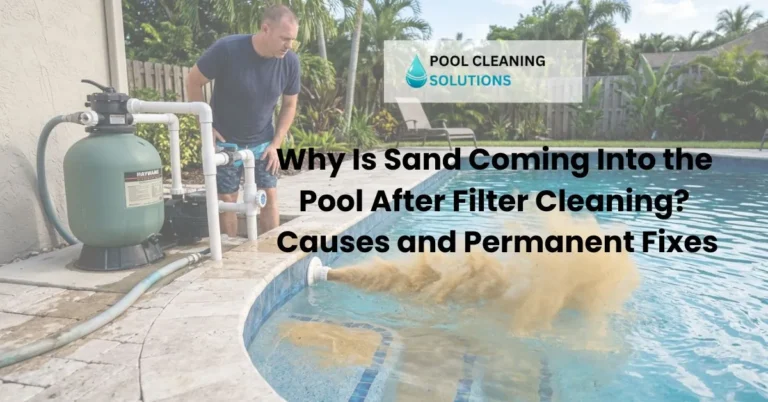
Why Is Sand Returning to My Pool After Backwashing?
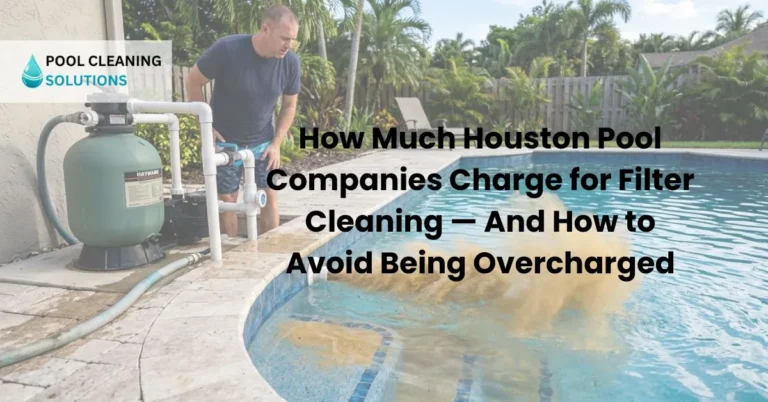
Sand in the pool means the lateral pipes at the bottom of your sand filter are cracked or broken. This is a mechanical repair, not a cleaning issue. Continued use with broken laterals will push sand into your pump impeller, causing further damage.
Why Is DE Powder Showing Up in My Pool?
DE powder in the pool means one or more internal filter grids are torn. The powder bypasses the damaged section and passes through the return lines back into your pool. Full teardown and grid inspection is required immediately.
What Does Professional Pool Filter Cleaning Cost in Houston?
Pricing varies based on filter type and service level.
| Service | Typical Houston Cost |
| One-time filter cleaning (cartridge) | $107–$130 per visit |
| Monthly maintenance (includes filter) | $100–$180 per month |
| Full DE teardown and recharge | $150–$250 |
| Algae treatment + filter cleaning | $180–$450 |
Monthly pool cleaning service in Houston typically costs $100–$180, which includes weekly visits for chemical balancing, skimming, brushing, and filter maintenance.
DIY cleaning saves money but requires time, the right chemicals, and a willingness to get your hands dirty. Professional service makes sense if you travel frequently, have a DE system, or your pool is larger than 20,000 gallons.
Should You DIY or Hire a Pro for Pool Filter Cleaning in Houston?
DIY makes sense when:
- You have a cartridge or sand filter (simpler process)
- You’re comfortable reading a pressure gauge
- Your pool is average-sized (15,000–20,000 gallons)
- You can commit to checking your filter every 2–3 weeks
Hire a professional when:
- You have a DE filter (requires precise grid reassembly)
- Your pressure is spiking repeatedly and you can’t identify why
- You’ve been away and the pool has gone green
- You want documented service records for your equipment warranty
Houston’s weather is demanding on pools; intense heat, sudden storms, and heavy pollen all make your filter work harder, and filtration issues can affect the rest of your equipment if not addressed in time.