TL;DR
Houston pools get dirty faster than almost anywhere else in the country, and generic pool advice does not fix that. This guide covers the exact cleaning steps, chemistry rules, and Houston-specific triggers every pool owner needs to know.
Why This Guide Is Different From Everything Else You’ve Read
Most pool guides online are maintenance guides. They mix equipment repairs, winterization, and renovation into one jumbled article.
This guide is specifically about cleaning. It covers the actual process of keeping your Houston pool blue, safe, and swim-ready week after week.
If your pool keeps going green, cloudy, or dirty despite your best efforts, this guide was written for you.
Why Houston Pools Get Dirty 2x Faster Than Other Cities
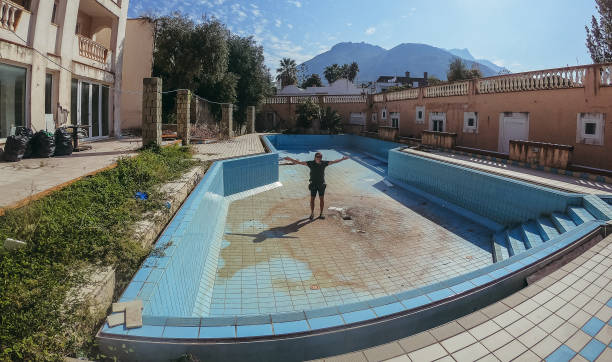
Houston pools get dirty faster because of the climate, not because of anything you are doing wrong.
Humid subtropical zone
Houston sits in a humid subtropical zone. That means relentless UV rays, high humidity, warm water temperatures year-round, and a swim season that never really ends.
Algae Growth in Warm Water
The CDC confirms that warm water above 77 degrees Fahrenheit creates ideal conditions for algae and bacteria to grow rapidly. Houston pools stay above that threshold for most of the year.
Pollen Loads
Houston also has one of the highest oak tree pollen counts in the country. That pollen does not just float on the surface. It sinks, feeds algae, and clogs your filter within days of a bloom.
Gulf Coast storms
Add Gulf Coast storms that dump phosphates and organic debris directly into your pool, and you have a chemistry environment that fights you every single week.
This is not a maintenance problem. It is a Houston problem. And it requires a Houston-specific solution.
The Hidden Enemy: Houston’s Hard Water
Houston tap water is naturally hard. It contains high levels of calcium and magnesium minerals that most pool owners never think about.
Every time you top off your pool after evaporation, you are adding more minerals to the water. Over time, calcium builds up on your tile, inside your equipment, and along your waterline.
Hard water constantly pushes your pH and alkalinity out of range. That means the chemicals you add do not work the way they should, even when you add the right amounts.
Most Houston pool owners blame their chemicals when the water stays cloudy or unbalanced. The real cause is usually the water itself coming out of the tap.
A professional pool tech accounts for Houston’s water hardness in every chemical adjustment. That is something most DIY guides completely ignore.
Houston Weather Events That Wreck Your Pool Chemistry Overnight
A single Houston thunderstorm can undo a week of perfect pool chemistry in under an hour.
Heavy rain
Heavy rain dilutes your chlorine, crashes your pH, and floods your pool with phosphates and organic debris. Phosphates are algae food. More phosphates means faster algae growth after every storm.
Houston’s Harsh Weather
Houston’s hurricane season runs from June through November. That is six months of unpredictable storms, each capable of turning a clean pool green within 48 hours.
Knowing these weather triggers is the first step to staying ahead of them. The second step is having a cleaning process that responds to them quickly.
Pool Chemistry 101: The Numbers Every Houston Pool Owner Must Know
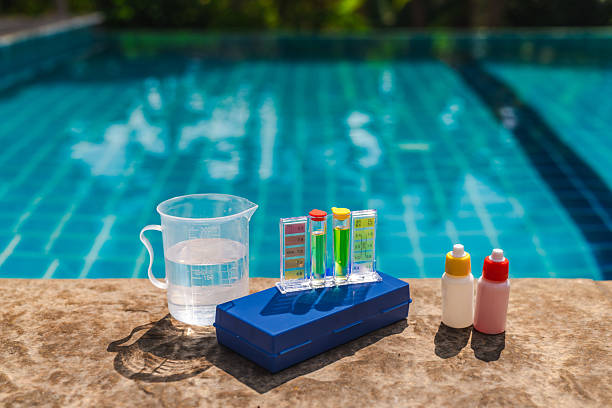
You cannot clean a Houston pool properly without understanding five core numbers. These are your non-negotiables.
- Free Chlorine should sit between 2 and 6 ppm. During peak Houston summer, keep it toward the higher end because UV rays burn through chlorine within hours on a hot day.
- pH should stay between 7.2 and 7.6. Houston’s hard water constantly pushes pH upward, so this number needs checking at least twice a week during summer.
- Total Alkalinity should sit between 80 and 120 ppm. Alkalinity acts as a buffer that keeps your pH stable. Low alkalinity means your pH swings wildly after every rain or chemical addition.
- Cyanuric Acid, also called CYA or stabilizer, should stay between 30 and 50 ppm for chlorine pools. For saltwater pools, the target is 60 to 80 ppm.
- Calcium Hardness should stay between 200 and 400 ppm. In Houston’s hard water environment, this number tends to creep up over time and needs monitoring.
All five numbers must be in range before any other cleaning step works properly. Chemistry first. Cleaning second. Always.
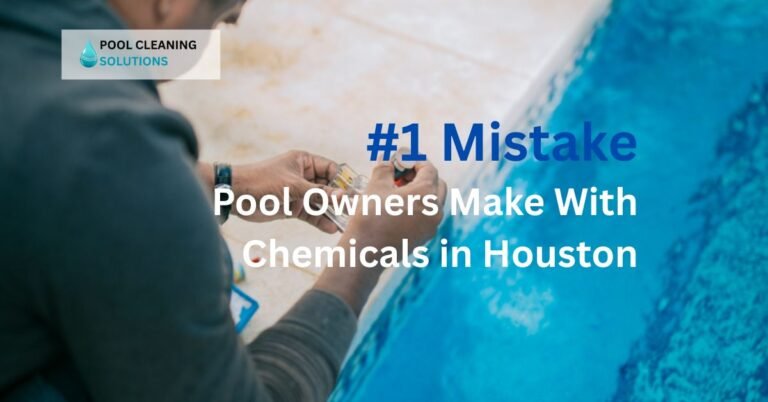
The Number One Mistake Houston Pool Owners Make With Chemicals
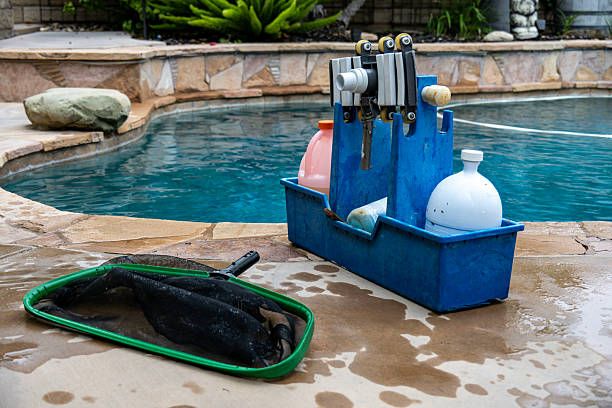
The single biggest chemical mistake Houston pool owners make is using stabilized chlorine tablets as their main sanitizer long-term.
Stabilized tablets like trichlor contain chlorine and cyanuric acid together. Every tablet you drop into the floater adds more CYA to your water. In Houston’s intense sun, this happens fast.
Within a few months of regular tablet use, CYA levels can climb above 70 to 100 ppm. At that point, your chlorine becomes largely ineffective at killing algae and bacteria, even when your test strip reads a perfectly normal chlorine level.
This condition is called chlorine lock. Your pool looks like it has chlorine. It does not actually have working chlorine. And your pool turns green.
The fix is to switch to liquid chlorine as your primary sanitizer. Liquid chlorine adds zero CYA. It gives you full chlorine effectiveness without the slow chemical buildup that tablets create over time.
What Is Chlorine Lock and Why Houston Pools Are So Prone to It
Chlorine lock happens when CYA levels get too high and neutralize your chlorine’s ability to sanitize.
Houston pools are especially vulnerable because the intense UV exposure pushes pool owners to keep adding tablets to maintain chlorine levels. More tablets means more CYA. More CYA means weaker chlorine. It becomes a cycle that gets worse every week.
Industry standard recommends keeping CYA between 30 and 50 ppm for outdoor chlorine pools. Many Houston pools that have been on tablets for a season or more are sitting at 80, 100, or even higher.
Signs you may have chlorine lock right now: your pool keeps turning green despite regular shocks, algae grows back within days of treatment, and your chlorine test reads fine but the water still looks off.
The solution depends on how high your CYA has gone. Mild cases can be corrected by partially draining and refilling with fresh water. Severe cases may require a full drain and acid wash.
A reliable pool service will test your CYA every month and catch this problem before it reaches the point of a costly drain and refill.
What a Complete Pool Cleaning Actually Includes
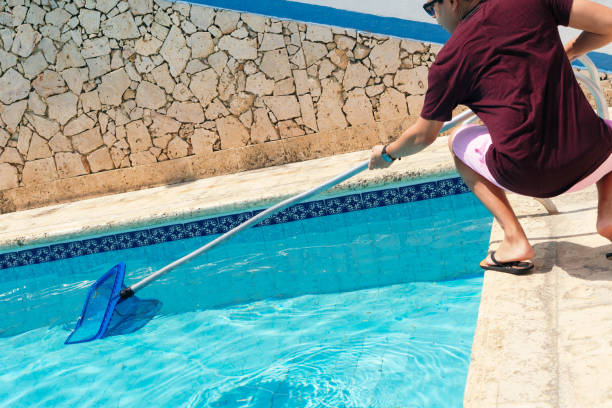
A proper pool cleaning is not just skimming leaves off the top. It covers ten distinct tasks that work together as a system.
Most Houston homeowners who clean their own pools do three or four of these tasks and skip the rest. That is usually why the pool keeps having problems.
Here is the full list of what a complete professional cleaning covers every single visit.
- Surface skimming to remove leaves, pollen, insects, and floating debris before they sink and decay.
- Brushing all walls, steps, benches, and the waterline tile to prevent algae from attaching and building a foothold on pool surfaces.
- Vacuuming the entire pool floor to remove settled debris, dirt, and fine particles the filter cannot pull out on its own.
- Emptying the skimmer basket, pump basket, and robotic cleaner basket so water flow stays unrestricted through your equipment.
- Backwashing or cleaning the filter depending on the filter type, to restore proper filtration pressure and efficiency.
- Testing all five chemical levels including free chlorine, pH, alkalinity, CYA, and calcium hardness.
- Adjusting chemicals in the correct sequence: alkalinity first, then pH, then chlorine. Adding them out of order reduces effectiveness.
- Shocking the pool when combined chlorine is detected or after heavy use, heavy rain, or a visible algae presence.
- Adjusting pump run times based on the season. Houston summers typically require eight to ten hours of daily pump operation.
- Performing a visual equipment inspection to catch early signs of leaks, failing seals, rising filter pressure, or equipment wear.
Step by Step: How to Keep a Houston Pool Blue All Summer
Follow these steps in this exact order every week. Skipping steps or changing the sequence is the most common reason pools stay problematic.
Step 1: Test Your Water Chemistry First
Always start with a water test before touching anything else. Your chemical readings tell you what the pool actually needs before you add a single thing.
Use a reliable liquid test kit or take a sample to your pool store for a full panel reading. Test strips give approximate readings but miss the precision you need for Houston’s demanding chemistry environment.
Step 2: Skim the Surface
Remove all floating debris from the surface before it sinks. Sunken debris decays, feeds algae, and stains the pool floor.
In Houston during oak pollen season from February through April, you may need to skim daily rather than weekly. Pollen accumulates fast and clogs filters quickly.
Step 3: Brush All Surfaces
Brush the walls, steps, benches, and waterline tile using a nylon brush for plaster pools or a soft brush for fiberglass and vinyl.
Algae spores attach to surfaces before they become visible. Weekly brushing dislodges them before they can take hold and turn your pool green.
Pay extra attention to corners, steps, and shaded areas. These spots get less circulation and are the first places algae establishes.
Step 4: Vacuum the Pool Floor
Vacuum the entire floor using a manual vacuum, suction cleaner, or robotic cleaner. Each method has tradeoffs depending on your pool’s debris level.
In Houston during heavy storm or pollen seasons, manual vacuuming gives you the most thorough result. Robotic cleaners are excellent for weekly maintenance cleaning between professional visits.
Step 5: Empty All Baskets
Check and empty the skimmer basket, pump basket, and robotic cleaner bag if applicable. A clogged basket restricts water flow to your pump and puts unnecessary strain on the motor.
In Houston during heavy debris seasons, baskets can fill within two to three days. Checking them mid-week is good practice.
Step 6: Clean or Backwash the Filter
Check your filter pressure gauge. If it reads 20 to 25 percent above your clean baseline pressure, it is time to backwash a sand or DE filter, or rinse a cartridge filter.
Cartridge filters in Houston typically need cleaning every four to six weeks during peak season. DE filters need backwashing when pressure rises. Sand filters are the most low-maintenance but least effective at fine particle removal.
A dirty filter is one of the most overlooked reasons a Houston pool stays cloudy even with correct chemistry.
Step 7: Balance Chemicals in the Correct Order
Adjust alkalinity first. Then adjust pH. Then add chlorine or any other sanitizer.
This sequence matters because alkalinity stabilizes the pH, and stable pH makes chlorine work efficiently. Adding chlorine to imbalanced water wastes product and money.
In Houston, recheck pH two to three times per week during summer. Hard water and heat push it out of range constantly.
Step 8: Shock the Pool When Needed
Shocking is not a weekly routine. It is a response to specific conditions.
Shock your pool after heavy rain or a storm, after a large pool party with heavy bather load, when combined chlorine is detected in your test, or when algae is visible anywhere in the pool.
For a standard 10,000 gallon Houston pool, one pound of calcium hypochlorite shock raises chlorine levels by approximately 5 ppm. Always shocked at dusk or night. Daytime shocking wastes most of the product before it can work.
Step 9: Set the Right Pump Run Time
Your pump circulates water through the filter. Without enough circulation, chemistry goes stagnant and algae blooms.
Run your pump eight to ten hours per day during Houston summer. In cooler months from November through February, six to eight hours is usually sufficient.
If you have a variable speed pump, running it at lower speed for longer periods is more energy efficient and provides better filtration than short high-speed cycles.
Step 10: Inspect Your Equipment
Spend two minutes looking at your equipment at the end of every cleaning. Check for water dripping from pump fittings, unusual noises, rising filter pressure after a recent cleaning, and salt cell buildup on saltwater systems.
Catching a small equipment issue early costs very little to fix. Ignoring it until the pump fails costs several hundred to several thousand dollars.
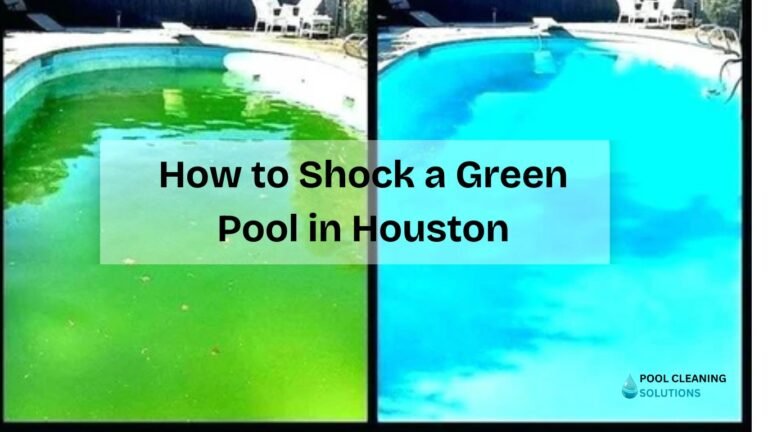
How to Shock a Green Pool Back to Blue in Houston
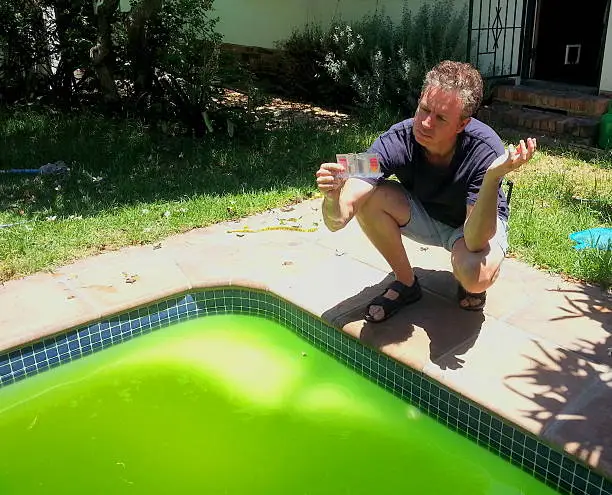
A green pool in Houston is almost always caused by one of three things: an algae bloom from low or ineffective chlorine, a phosphate spike after heavy rain, or chlorine lock from high CYA.
Identify the cause before you shock. Shocking a pool with chlorine lock will not work. The CYA is neutralizing the shock the same way it neutralized your regular chlorine.
If CYA is in a normal range between 30 and 50 ppm, follow this process to clear a green pool fast.
Test and record all five chemical levels. Balance alkalinity and pH first before adding any shock.
Calculate the correct shock dose based on your pool volume. For a light green pool, use two pounds of calcium hypochlorite shock per 10,000 gallons. For a dark green pool, use three pounds per 10,000 gallons.
Brush the entire pool thoroughly before adding shock. Brushing breaks up algae colonies on surfaces and allows the shock to reach and kill them.
Add the shock after dark and run the pump continuously overnight on full circulation. Do not add the shock through the skimmer.
Retest in the morning. If the water has shifted from green to cloudy gray or white, the shock is working. The algae is dying.
Run the filter continuously and clean or backwash it every 12 to 24 hours until the water clears. A pool heavily loaded with dead algae will clog a filter fast.
Most Houston pools take 48 to 72 hours to go from green to clear using this process. Do not swim until free chlorine drops back below 5 ppm and the water is fully clear.
When Your Pool Needs an Acid Wash, Not Just a Shock
An acid wash is necessary when algae staining or mineral scale has penetrated the pool surface itself. Shocking and cleaning cannot remove it.
Signs you need an acid wash include dark green or black staining embedded in the plaster that does not brush off, persistent brown or copper-colored scale lines along the waterline, or a pool that has sat without care for several months.
An acid wash involves fully draining the pool, applying a diluted muriatic acid solution to the plaster, scrubbing, and rinsing. It removes a thin layer of the plaster surface along with the stains and scale.
This is not a DIY project for most homeowners. It requires proper safety equipment, acid handling knowledge, and legal wastewater disposal. In most Houston municipalities, pool water cannot be discharged into storm drains.
Acid washing costs between $300 and $600 on average in the Houston area. It is money well spent when a pool surface has deteriorated beyond what a standard shock and clean can restore.
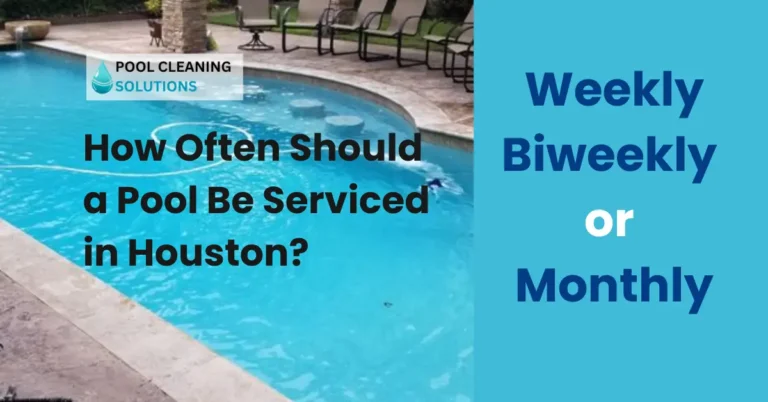
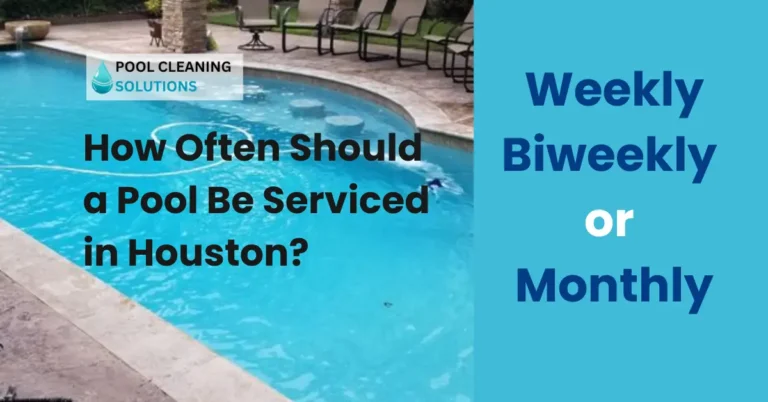
How Often Should a Pool Be Serviced in Houston?
Houston pools need professional cleaning at minimum once per week. This is not a suggestion. It is what the climate demands.
Houston’s combination of intense UV, warm water, heavy pollen, storm events, and year-round pool use creates a chemistry and debris load that biweekly or monthly service simply cannot keep up with.
Industry professionals across Houston consistently recommend weekly service for residential pools. Several local providers state this directly in their service guidelines based on years of operating in this specific climate.
Biweekly service can work in limited situations: pools with full covers, minimal use, and high-end automated filtration. Even then, water chemistry should still be tested and adjusted every seven days.
Monthly service is not adequate for any actively used Houston pool. A pool without professional attention for 30 days in Houston summer can go green within the first week and require a full recovery treatment by the time service arrives.
Your Houston Pool Maintenance Schedule by Season
Houston has four distinct seasons for pool care, even though the pool never fully closes. Here is what each season demands.
Spring: February through April
Spring is your most chemically demanding season. Oak pollen falls in massive quantities and clogs filters within days. Rebalance chemistry after every significant rainfall. Clean your cartridge filter every two to three weeks during peak pollen. Brush surfaces weekly to prevent algae establishing in warming water.
Summer: May through September
Summer is your highest-effort season. Test free chlorine and pH at least twice per week. Run your pump eight to ten hours daily. After any party or heavy use, test and shock within 24 hours. After any storm during hurricane season, remove debris immediately, run the pump continuously for 24 to 48 hours, test all chemistry, and shock if free chlorine has dropped significantly.
Fall: October through November
Leaf drop increases debris load significantly in fall. Skim and vacuum more frequently. Clean your filter thoroughly at the end of the leaf season to restore flow heading into winter. Dial chlorine demand down gradually as temperatures drop and bather load decreases.
Winter: December through January
Houston pools do not fully close or winterize the way northern pools do. Reduce pump run time to six to eight hours per day. Maintain chemistry in range even during months of reduced use. Check equipment for freeze protection on any nights where temperatures are forecast to drop below 32 degrees Fahrenheit. Most Houston winters require only light maintenance, not full winterization.
What to Do After a Houston Storm
Storm response is a skill every Houston pool owner needs. A missed post-storm recovery is one of the most common reasons pools go green in this city.
Before a storm arrives, raise your free chlorine to the upper end of its target range. Lower pH slightly to around 7.2. Secure all pool equipment covers and turn off gas to any heaters.
After the storm, remove all visible debris from the pool immediately. Do not let leaves and debris sit on the pool floor overnight. They release phosphates as they decay and those phosphates accelerate algae growth.
Run the pump continuously for 24 to 48 hours after the storm. Test all chemistry and shock if free chlorine has dropped. Check your filter pressure and backwash or clean as needed.
If phosphate levels have spiked, which often happens after significant rainfall, apply a phosphate remover before the algae has a chance to feed on them.
Can You Clean a Houston Pool Yourself?
You can clean your own pool. But Houston’s climate makes reliable DIY maintenance genuinely difficult for most homeowners.
The Houston sun can destroy your free chlorine levels in a single afternoon. A 15-minute thunderstorm can crash your pH and alkalinity overnight. Oak pollen can clog your filter in three days.
These are not problems that wait for the weekend. They require response within 24 to 48 hours or the situation escalates into a full green pool recovery, which costs significantly more than consistent weekly service.
DIY pool care also has hidden costs most homeowners do not account for. Test kits, chemicals, brushes, vacuums, and replacement filter cartridges add up. Chemical waste from incorrect dosing adds more. Equipment damage from running a pump with a clogged basket or a dirty filter adds more still.
The honest math for most Houston homeowners is that professional weekly service costs less over a year than the combination of DIY supplies, mistakes, and recovery treatments.
That said, if you enjoy the process and have the time to stay consistent, DIY pool care is absolutely possible in Houston. The requirement is not just weekly cleaning but chemistry testing two to three times per week during summer. Most busy homeowners cannot maintain that schedule reliably.
Why Some Houston Pools Never Stay Clean
Some Houston pools go green and come back clean and then go green again every three to four days in a repeating cycle. There is always a specific reason this happens.
The most common cause is chlorine lock from elevated CYA. The pool looks treated. The chlorine is not actually working. Algae grows back almost immediately after every shock treatment.
The second most common cause is a phosphate problem. High phosphate levels in the water feed algae so aggressively that even well-balanced chlorine struggles to keep up. Phosphates come from storm runoff, fertilizer overspray, decaying leaves, and some pool chemicals.
The third cause is a dirty or undersized filter that cannot remove fine particles and algae spores fast enough. The pool gets shocked, algae dies, but dead algae particles recirculate through a dirty filter and the water never fully clears.
Breaking the cycle requires identifying which cause is driving it. Testing CYA, phosphate levels, and filter pressure together usually reveals the answer within one service visit.
A reliable recurring service identifies these patterns and corrects them systematically. One-time cleaning visits treat the symptom. Recurring service fixes the cause.
Difference Between Weekly and Monthly Pool Cleaning Services in Houston
Weekly service and monthly service are not the same thing delivered less often. They are fundamentally different levels of care with very different outcomes in Houston’s climate.
| Comparison Point | Weekly Service | Monthly Service |
| Visits per month | 4 visits | 1 visit |
| Chemistry monitoring | Checked every 7 days | Checked every 30 days |
| Storm response | Within days of any weather event | Up to 30 days delayed |
| Algae prevention | Proactive and consistent | Reactive after damage is done |
| Filter condition | Monitored and addressed regularly | Can deteriorate for weeks unnoticed |
| Equipment issue detection | Caught early before damage occurs | Often found after failure happens |
| Suitable for active Houston pools | Yes, the clear choice | No, not adequate for this climate |
| Suitable for covered unused pools | Acceptable option | Possibly, only with weekly self-testing |
How to Choose a Reliable Pool Service Company in Houston
The right pool service company treats your pool like a recurring responsibility, not a one-time job.
Ask these five questions before hiring anyone.
- Do you provide a written service report after every visit? A professional service documents what they did, what they tested, and what they adjusted on every single visit. No report means no accountability.
- Do you use liquid chlorine or stabilized tablets as your primary sanitizer? Tablet-based programs raise CYA over time. A quality service uses liquid chlorine and manages CYA proactively.
- What is your response time for a green pool or post-storm emergency? A reliable company commits to a specific response window. Vague answers mean you are on your own when problems happen.
- Are your technicians certified? Look for CPO certification, which stands for Certified Pool Operator. This is the industry standard credential that confirms a technician understands water chemistry at a professional level.
- Do you offer a service guarantee? A confident company guarantees their work. If your pool goes green on their watch due to a chemistry error, they fix it at no charge.
Red flags to avoid include companies that cannot tell you exactly what chemicals they use, companies with no online reviews or documentation of their work, and companies that push long-term contracts before demonstrating any results.
Best Pool Cleaning Services in Houston: What Separates Good From Average
The best pool cleaning companies in Houston share four qualities that average companies consistently lack.
Consistent scheduling
They show up on the same day every week without exception. Consistent scheduling is not just convenient. It means your pool chemistry is being monitored on a predictable cycle, which is what prevents problems from escalating.
Timestamped service reports
They provide timestamped service reports with before and after photos after every visit. You should be able to see exactly what your pool looked like when the tech arrived and what it looked like when they left. This level of transparency is a sign of a company that is confident in their work.
Manage CYA proactively
They manage CYA proactively and use liquid chlorine as the primary sanitizer. This one practice alone separates serious pool companies from those who are just going through the motions.
Catch equipment problems
They catch equipment problems before they become equipment failures. A quality tech notices rising filter pressure, a dripping fitting, or a salt cell showing calcium buildup during a routine visit. Catching these early saves you hundreds or thousands in repair costs.
Affordable Prices
On pricing, good swimming pool cleaning companies in houston are also transparent about what you are actually paying for. Standard weekly service in Houston runs between $80 and $250 per month depending on what is included. Always calculate the all-in cost including chemicals before comparing quotes. A cheap monthly rate that excludes chemicals and recovery treatments will almost always cost you more by the end of the year than a properly priced weekly plan that covers everything.
Emergency Pool Cleaning Services in Houston
Emergency pool cleaning is for situations that cannot wait for a scheduled visit: a pool that has gone dark green before a weekend event, a post-hurricane storm recovery, or a sudden algae takeover from a chemistry failure.
A quality emergency service response in Houston should begin within 24 hours of your call. The process involves testing all chemistry, correcting the cause of the problem, shocking and treating appropriately, and then running continuous filtration until the pool clears.
Realistic timeline for a green pool emergency recovery is 48 to 72 hours for light to moderate cases. Severely neglected pools with embedded staining may require a drain and acid wash, which adds time and cost.
Emergency service pricing in Houston typically ranges from $150 to $400 depending on the severity of the situation and the size of the pool.
The best way to avoid emergency service costs is a reliable recurring weekly program. A pool that is serviced consistently every seven days almost never requires emergency intervention.
Saltwater Pool vs Chlorine Pool in Houston: Which Is Actually Lower Maintenance?
Saltwater pools are popular in Houston because they produce chlorine automatically and deliver a softer feel on skin and eyes. But they are not maintenance-free.
A saltwater pool still needs weekly skimming, brushing, and vacuuming. Water chemistry still needs testing and adjusting. The difference is in how chlorine is delivered, not in how much physical cleaning is required.
Houston’s hard water creates a specific problem for saltwater pools. Calcium builds up on the salt cell over time and reduces its ability to generate chlorine effectively. Salt cells need to be inspected and cleaned every two to three months in Houston’s hard water conditions.
For day-to-day cleaning, saltwater and chlorine pools require essentially the same effort. The advantage of saltwater is more consistent chlorine delivery with less manual chemical handling. The disadvantage is higher equipment cost and the need to maintain the salt cell specifically.
Neither system eliminates the need for professional weekly service in Houston. Both systems face the same climate challenges.
How Your Pool Equipment Affects How Clean Your Water Stays
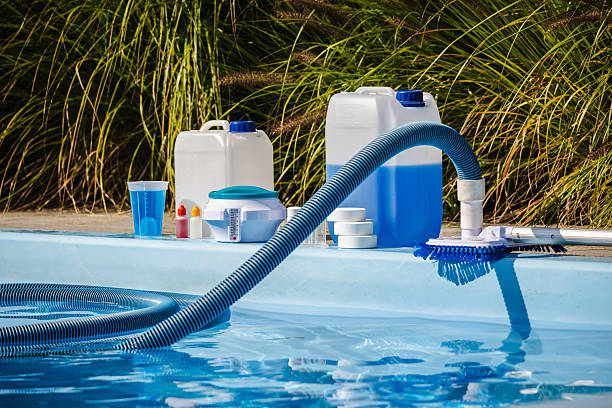
Your pool is only as clean as the equipment running it. Bad equipment means bad water, regardless of how well you clean the surfaces.
The pump is the foundation. It moves water through the filter and circulates chemicals throughout the pool. A pump that runs too few hours per day leaves dead zones where algae develops. Run it at least eight hours daily in Houston summer.
The filter is your water’s purification system. A dirty or undersized filter cannot remove fine particles, algae spores, or debris effectively. This is one of the most overlooked reasons Houston pools stay cloudy despite correct chemistry and regular cleaning.
Cartridge filters in Houston need cleaning every four to six weeks during heavy season. DE filters need backwashing when pressure rises. Sand filters need replacement every five to seven years as the media degrades.
The salt cell on saltwater systems needs inspection every two to three months. Calcium scale builds up on the cell plates and reduces chlorine output significantly. A cell running at half capacity explains many chronic chemistry problems in Houston saltwater pools.
Visual equipment inspections during every cleaning visit catch problems early. A dripping fitting, a humming pump motor, or a filter pressure that will not drop after backwashing are all early warning signs that cost far less to fix at that stage than later.
Key Takeaways: What Every Houston Pool Owner Should Remember
Houston pools require weekly professional cleaning because the climate, hard water, pollen, and storm season make every other schedule inadequate for an actively used pool.
Chemistry comes before cleaning. All five numbers, free chlorine, pH, alkalinity, CYA, and calcium hardness, must be in range before any cleaning step fully works. Most pool problems trace back to chemistry that is out of balance.
Chlorine lock is the hidden cause of most recurring green pools in Houston. If your pool keeps going green despite regular shocking, test your CYA. If it is above 70 ppm, you have found your problem.