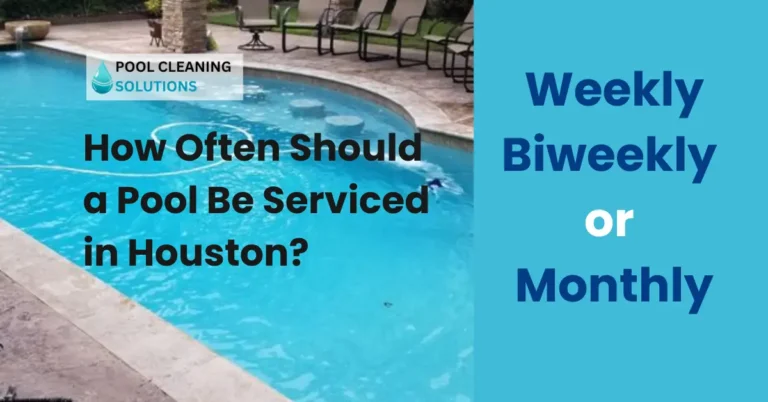
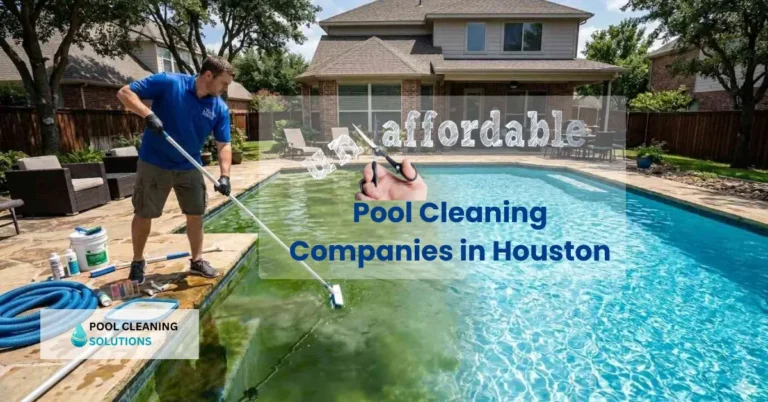
Weekly service is the right choice for most Houston pools. Houston’s climate is uniquely harsh on pool chemistry. Heat above 85°F burns chlorine twice as fast. Rain dilutes it further. Algae can establish in under 7 days. Biweekly works only for low-use pools in winter. Monthly is not a maintenance plan in Houston. It is damage control.
The Quick Answer According to Pool Type
Not every Houston pool has the same needs. Swimming pool cleaning depends upon your pool type, usage, and location change the right frequency.
| Pool Type | Recommended Frequency | Key Reason |
| In-ground, actively used, full sun | Weekly | High chlorine demand, debris daily |
| In-ground, near trees or landscaping | Weekly | Organic debris spikes phosphates fast |
| In-ground, rarely used, covered | Biweekly (Nov to Feb only) | Lower UV and bather load |
| Saltwater pool, Houston summer | Weekly | Heat degrades pH and alkalinity despite salt cell |
| Above-ground pool, Houston summer | Weekly | Smaller water volume makes chemistry unstable faster |
| Any pool after a storm | Immediate check required | Rain dilutes chlorine and drops pH within hours |
How Houston’s Climate Makes Your Pool Chemistry Unstable Faster
Houston is not an average city for pool ownership. Step by step pool cleaning guide will help to understand the different scenarios. The combination of heat, humidity, and rainfall creates a chemistry environment that demands faster intervention than almost any other U.S. city.
Chlorine depletion rate:
At 85°F, UV and heat consume free chlorine at roughly twice the rate of cooler climates. At 95°F, a pool can go from safe to zero chlorine in 3 to 5 days.
Phosphate loading from rain:
Every inch of rainfall washes airborne phosphates, lawn fertilizer runoff, and organic debris into the water. Phosphates are the primary food source for algae. Houston’s 50+ annual inches of rain means this is a recurring problem, not an occasional one.
Humidity and algae spore activity:
Dry climates slow algae spore activation. Houston’s average relative humidity of 75 to 90 percent keeps spores active year-round. Even in winter, Houston pools can develop algae problems if chemistry drifts.
Understanding exactly why Houston pools become dirtier faster than other cities helps explain why every recommendation in this guide defaults to weekly.
The True Cost of Choosing the Wrong Service Frequency
Competitors in Houston talk about service frequency in terms of cost per month. That is the wrong frame. The right frame is total annual cost including recovery events.
Annual cost comparison by service plan:
| Plan | Monthly Cost | Avg Emergency Events Per Year | Avg Emergency Cost | Estimated Annual Total |
| Weekly service | $200 | 0 to 1 | $0 to $150 | $2,400 to $2,550 |
| Biweekly service | $110 | 1 to 3 | $150 to $400 each | $1,920 to $3,240 |
| Monthly service | $60 | 3 to 6 | $150 to $500 each | $1,170 to $3,720 |
Monthly looks cheapest at first. Across a full Houston year, it is often the most expensive option. And it excludes the cost of plaster damage, equipment wear from imbalanced water, and acid washing if algae staining sets in.
Every time you choose a lower service frequency in Houston, you are not saving money. You are transferring the cost to a later emergency bill.
The difference between service at the swimming pool weekly and biweekly cleaning is not just cost. It is the difference between a pool that is always ready and a pool that is always recovering.
What Bad Pool Service Looks Like in Houston
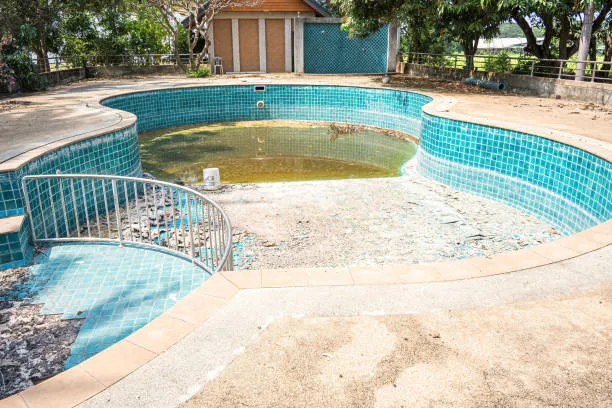
Most Houston homeowners do not know what to look for on a service visit. That is how low-quality providers stay in business.
A pool tech who is not doing the job properly will:
- Show up, skim the surface, and leave in under 10 minutes
- Never brush the walls or steps
- Skip chemistry testing if the water “looks clear”
- Fail to empty the pump basket
- Never inspect equipment
- Provide no written record of what was done
A pool that “looks clean” is not necessarily safe or balanced. Algae can be present at a level invisible to the eye and still be multiplying. pH can be dangerously high or low with no visible sign. Cyanuric acid can be so high it renders chlorine ineffective even at correct concentration levels.
What every legitimate service visit must include:
- Written or digital log of chemistry readings taken that day
- pH, free chlorine, total alkalinity, and cyanuric acid recorded
- Confirmation of all physical tasks completed (brush, vacuum, baskets)
- Note of any equipment issue observed
If your current provider cannot show you that record within 24 hours of every visit, your pool is not being maintained. It is being visited.
Pool Chemistry Numbers Every Houston Owner Should Know
You do not need to manage your own chemistry. But you should know what healthy numbers look like so you can verify your provider is hitting them.
| Parameter | Target Range | What Happens If Off |
| Free Chlorine | 1 to 3 ppm | Below 1: algae and bacteria risk. Above 5: skin irritation |
| pH | 7.2 to 7.6 | Below 7.2: corrosive to equipment. Above 7.8: chlorine becomes ineffective |
| Total Alkalinity | 80 to 120 ppm | Low: pH swings wildly. High: cloudy water and scale |
| Cyanuric Acid (Stabilizer) | 30 to 50 ppm | Above 80: chlorine loses effectiveness even at correct levels |
| Phosphates | Under 100 ppb | Above 500: algae resistant to normal chlorine treatment |
| Calcium Hardness | 200 to 400 ppm | Low: etches plaster. High: scale on tiles and equipment |
Houston-specific note: cyanuric acid builds up in outdoor pools over time because it does not evaporate. High stabilizer levels are one of the most common hidden reasons a Houston pool keeps going green despite regular chlorine additions. A qualified service tech should check and address this annually.
Signs Your Current Service Schedule Is Not Suitable
Your pool will show you when the frequency is wrong before it becomes an emergency. Most Houston homeowners miss these early signals.
Early warning signs your pool needs more frequent service:
- Waterline tile developing a greasy or scaly ring between visits
- Water color shifting from clear blue to slightly hazy or green-tinted
- Strong chlorine smell (this signals chloramines, not excess chlorine)
- Algae appearing on the shaded side of steps or corners first
- Eyes or skin irritated after swimming even when water “looks fine”
- Filter pressure rising faster than usual between cleanings
What those signs mean in Houston pool specifically:
A greasy waterline ring means organic loading is outpacing your service frequency. A hazy blue-green tint means algae is already present at early bloom stage. A strong chlorine smell means combined chlorine (chloramines) has formed because free chlorine has been overwhelmed by bather waste or organic debris.
None of these signs require a catastrophe. They require an earlier service visit. If you notice any of them, do not wait for your scheduled day. Call your provider.
If your pool turns green means it has already moved past these warning signs into a visible bloom, the green pool recovery process is different from routine maintenance.
What Happens to Pool Equipment When Service Is Infrequent
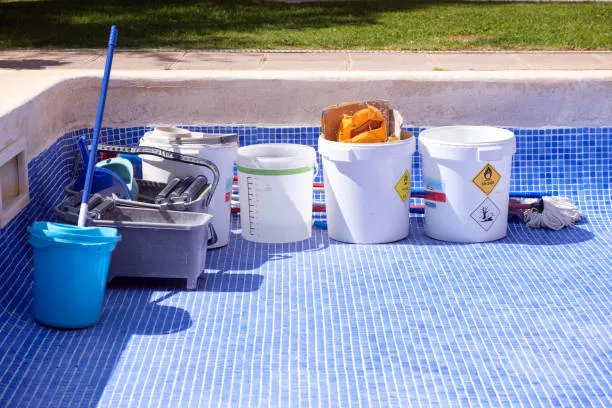
Pool chemistry damage to equipment is slow, invisible, and expensive. Most Houston homeowners connect equipment failures to bad luck. The actual cause is usually months of improper water chemistry.
How infrequent service damages equipment:
Pump and motor:
Running dirty water with high debris loads forces the pump to work harder. Impeller wear accelerates. Motors running hot due to restricted flow fail years earlier than properly maintained systems.
Filter:
Whether sand, cartridge, or DE, a filter clogged with algae and debris cannot do its job. Flow restriction puts pressure on the pump and reduces sanitizer circulation. A filter that should last 5 to 7 years may need replacement in 2 to 3 years.
Heater:
Low pH water is acidic and corrodes heat exchanger coils from the inside. High pH causes calcium scale buildup that insulates the coils and causes overheating. Heater repairs in Houston range from $400 to $1,500. Full replacement runs $1,500 to $3,500.
Plaster and tile:
Unbalanced calcium hardness and pH cause plaster etching and tile scale. Acid washing to remove staining costs $500 to $1,500. Full replaster runs $5,000 to $15,000 depending on pool size.
Weekly service is not just about clean water. It protects a $5,000 to $20,000 equipment and surface investment.
When to Call for Unscheduled Pool Service in Houston

Knowing how to identify a reliable Houston pool service company before you hire is the first step. Verifying they deliver on that reliability is what keeps your pool healthy long-term.
There are specific situations where waiting for your next scheduled visit will cost you more than the unscheduled visit itself.
Call your pool company the same day if:
- Any storm drops more than 1 inch of rain in your area
- Water temperature drops below 40°F overnight (freeze risk to equipment)
- You notice water level dropping more than 0.5 inches per day (possible leak)
- A strong chemical or sulfur smell is coming from the water
- Your pool pump is making grinding, humming, or no sound at all
- Green or black coloring appears anywhere in the water
- You are hosting a large swim event within 48 hours
Timing matters. A pool that turns green the day before a party cannot be fixed overnight. Chemistry treatment and filtration take 24 to 72 hours to restore a bloom pool to swim-safe status.
The difference between a manageable pool problem and an emergency pool service is usually 24 to 48 hours.