Most Houston pool filters need professional cleaning every 3 to 4 months, plus quick rinses or backwashes monthly during peak season. Cartridge filters need cleaning every 4 to 8 weeks in summer, sand filters need backwashing every 4 to 6 weeks, and DE filters need backwash plus DE recharge every 4 to 8 weeks during heavy use.
The real trigger is the PSI gauge. When your filter pressure rises 8 to 10 PSI above the clean baseline, it needs cleaning regardless of the calendar. Houston’s pollen, hurricane season debris, and year-round swim use make filter loads heavier than in most U.S. cities, so most local pools land on the more frequent end of national guidelines.
How often do Houston pool filters need cleaning by type?
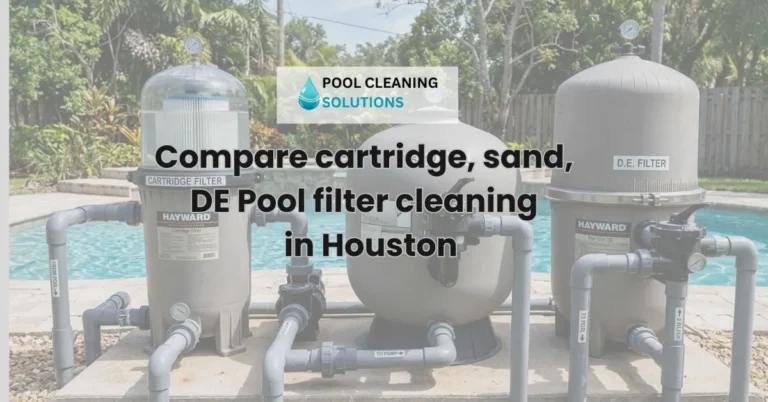
Houston pool filter cleaning frequency depends on the filter type you own. Cartridge filters need the most frequent attention, sand filters need regular backwashing, and DE filters need backwash plus a full grid teardown a few times per year.
Below is the baseline schedule before adjusting for season or pool use.
Houston Filter Cleaning Frequency Table
| Filter Type | Quick Clean / Backwash | Full Deep Clean | Media Replacement |
| Cartridge | Hose rinse every 4 to 8 weeks | Chemical soak every 3 to 4 months | Replace every 2 to 4 years |
| Sand | Backwash every 4 to 6 weeks | Deep clean and inspect annually | Replace sand every 5 to 7 years |
| DE | Backwash and recharge every 4 to 8 weeks | Full grid teardown every 3 to 4 months | Replace grids every 7 to 10 years |
The PSI rule overrides the calendar
A clean filter sits at a baseline pressure, usually 8 to 15 PSI for most residential systems. Clean it when the gauge climbs 8 to 10 PSI above that number, even if the last clean was last week. Skip the calendar if your pressure already says it’s time.
How often should I clean a cartridge filter in Houston?
Houston cartridge filters need a hose rinse every 4 to 8 weeks and a full chemical soak every 3 to 4 months. Most cartridge owners in Houston end up doing 3 to 4 deep cleans per year because of pollen, sunscreen oils, and year-round use.
Cartridge filters trap finer particles than sand. They also clog faster because there is no backwash option to flush out trapped debris.
Cartridge cleaning schedule for Houston
- Every 4 to 8 weeks: Hose-rinse during peak swim months (May to September).
- Every 3 to 4 months: Full chemical soak with degreaser to remove oils and calcium scale.
- Every 2 to 4 years: Replace the cartridge entirely.
- Pressure-triggered: Clean immediately if PSI rises 8 to 10 above baseline.
Why Houston cartridges clog faster
Houston pool cartridges deal with three concentrated loads: live oak pollen from February through May, sunscreen oils from heavy summer use, and calcium scale from hard tap water. A cartridge that lasts 18 months in Phoenix may only last 12 months in Houston without proper deep cleaning.
How often should I backwash a sand filter in Houston?
Houston sand filters need backwashing every 4 to 6 weeks during peak season and every 6 to 8 weeks in winter. A full deep clean and inspection should happen at least once a year, and the sand media itself needs replacement every 5 to 7 years.
Sand is the most forgiving filter type but also the coarsest. Houston pools with sand filters often see slightly cloudier water than cartridge or DE systems.
Sand filter schedule for Houston
- Every 4 to 6 weeks (summer): Backwash for 3 to 5 minutes until the sight glass runs clear.
- Every 6 to 8 weeks (winter): Backwash on the same trigger but expect longer intervals.
- Once a year: Pull the multiport valve, inspect laterals, and chemically clean the sand bed.
- Every 5 to 7 years: Replace the silica sand entirely.
Watch for sand returning to the pool
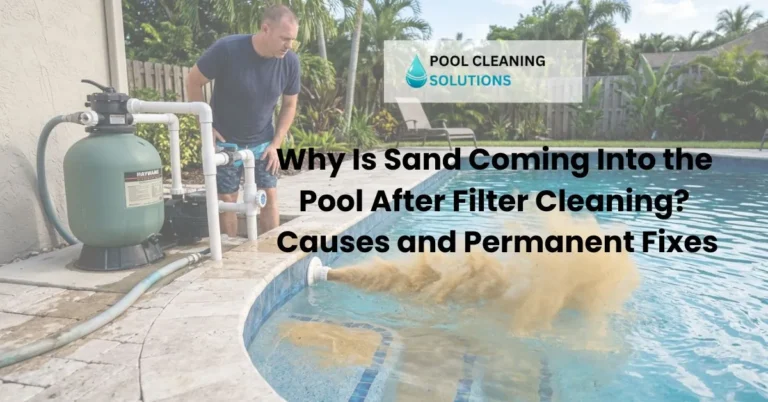
If you see sand grains on your pool floor or near return jets, a lateral inside the filter has cracked. Backwashing more often will not fix this. The filter needs a full teardown and lateral replacement before continuing to use it.
How often should I clean a DE filter in Houston?
Houston DE filters need backwashing and a fresh DE powder recharge every 4 to 8 weeks during peak season. A full grid teardown, manifold inspection, and tank cleaning should happen every 3 to 4 months. Most Houston DE pools land on 3 to 4 full cleans per year.
DE filters give the cleanest water of any system. They also require the most labor per cleaning.
DE filter schedule for Houston
- Every 4 to 8 weeks: Backwash and recharge with fresh DE powder.
- Every 3 to 4 months: Full disassembly, grid inspection, and tank flush.
- Once a year: Inspect grids for tears, replace damaged grids, and check manifold integrity.
- Every 7 to 10 years: Replace the grid set entirely.
Why DE powder must be replaced after every backwash
Backwashing flushes out the dirty DE coating along with trapped debris. Skipping the recharge step leaves the grids bare, which means no real filtration is happening. Pools running on backwashed-out DE filters often look clear at first then turn cloudy within days.
Does Houston’s climate change how often I clean my pool filter?
Yes. Houston’s climate forces more frequent filter cleaning than most U.S. cities because of four specific local factors: live oak pollen, hurricane season debris, year-round swim use, and hard mineral-rich tap water.
A pool in Phoenix or Denver runs the same filter for 5 to 6 months between deep cleans. A Houston pool rarely makes it past 4 months without one.
The four Houston factors that shorten filter intervals
- Live oak pollen (Feb to May). Oak pollen counts in Houston spiked from 326 to 3,298 grains per cubic meter in one week in March 2026. That kind of load can saturate a clean cartridge within days.
- Hurricane season (June 1 to Nov 30). Heavy rains push organic debris, phosphates, and contaminants into the filter all at once. Post-storm filter cleans are routine in Houston.
- Year-round use. Most Houston pools are used 8 to 10 months a year. That’s nearly double the bather load of a northern pool.
- Hard water. Houston tap water averages 75 to 110 ppm calcium hardness. Calcium scale builds up inside filter media and requires acid soak to remove.
How often should I clean my pool filter during each Houston season?
Houston pool filters need different cleaning frequencies in spring, summer, fall, and winter. Spring pollen and summer storms create the heaviest filter loads. Winter is the only true low-demand season, and even then filters need monthly checks.
The right schedule changes month to month, not just season to season.
Houston Seasonal Filter Cleaning Calendar
| Season | Months | Cartridge | Sand | DE |
| Spring (pollen) | Feb to May | Every 4 weeks | Backwash every 3 to 4 weeks | Backwash every 4 weeks |
| Summer (peak) | Jun to Sep | Every 4 to 6 weeks | Backwash every 4 to 6 weeks | Backwash every 4 to 6 weeks |
| Fall (storms + leaves) | Oct to Nov | Every 6 weeks | Backwash every 5 to 6 weeks | Backwash every 6 weeks |
| Winter (low demand) | Dec to Jan | Every 8 to 12 weeks | Backwash every 8 weeks | Backwash every 8 weeks |
Why spring is the hardest season for Houston filters
Live oak pollen in Houston peaks in March and can release for 6 to 8 weeks once trees start blooming. A single windy day in Memorial or Bellaire can coat a pool surface in visible yellow pollen overnight. This is the single most demanding period of the year for any Houston pool filter.
How often should I clean my filter after a Houston storm or hurricane?
Clean your pool filter within 24 to 48 hours of any major Houston storm. Heavy rain dilutes chlorine, raises phosphates, and pushes debris into the system all at once. A filter that runs unchecked for a week after a storm often ends up needing a full teardown instead of a routine clean.
Hurricane season runs June 1 through November 30 in Houston. Plan for 1 to 3 unplanned filter cleans during that window.
Post-storm filter cleaning checklist
- Within 24 hours: Skim debris from the surface and empty skimmer baskets.
- Within 48 hours: Backwash sand or DE filters; rinse cartridges with a hose.
- Within 1 week: Schedule a full chemical clean if the filter was heavily loaded.
- Test water chemistry immediately: Storms strip chlorine and feed phosphates, which both worsen filter load.
The post-storm filter mistake most Houston homeowners make
Most homeowners wait until they see cloudy water to address the filter after a storm. By that point, the filter has already failed and the pool needs shock treatment plus a deep clean. Acting within 48 hours prevents the green pool entirely.
How often should I clean my filter during Houston pollen season?
Plan for one extra filter cleaning between February and May to handle Houston pollen season. Most cartridge owners go from every 8 weeks down to every 4 to 5 weeks. Sand and DE owners shorten backwash intervals to every 3 to 4 weeks.
Live oak is the main culprit. Pine, ash, and elm contribute to the load.
Pollen season adjustments
- Cartridge filters: Switch from a 6 to 8 week rinse cycle down to a 4 week rinse cycle.
- Sand filters: Backwash every 3 to 4 weeks instead of every 4 to 6 weeks.
- DE filters: Backwash and recharge every 3 to 4 weeks instead of every 6 to 8 weeks.
- Skimmer baskets: Empty 2 to 3 times per week during heavy pollen days.
The visible pollen test
If you can see yellow-green dust on your pool deck, pool cover, or car windshield, your filter is already loading heavily. That is the cue to bring the next cleaning forward, not wait for the PSI gauge.
What signs tell me my pool filter needs cleaning right now?
Five signs tell you the filter needs cleaning regardless of when you cleaned it last: pressure gauge 8 to 10 PSI above baseline, cloudy water, weak return jets, debris coming back into the pool, and unusual pump noise.
Any one of these means your filter is no longer doing its job.
The 5 filter cleaning triggers
- PSI gauge rises 8 to 10 above clean baseline. The most reliable indicator.
- Pool water turns cloudy. Even with balanced chemistry, cloudy water usually means filter saturation.
- Return jets feel weak. Reduced flow means blockage somewhere in the filter media.
- Sand or DE coming back into the pool. A lateral or grid has failed and needs replacement.
- Pump sounds louder than usual. The motor is straining against filter resistance.
When to call a professional instead of cleaning it yourself
A monthly hose-off is a DIY job. A full chemical soak, grid inspection, or lateral replacement is not. If you’re seeing sand or DE return, hearing pump strain, or cleaning more often than the schedule suggests, call a CPO-certified Houston technician. Houston Pool Cleaning Services handles all three filter types and provides a 30-day clog-free guarantee on every professional clean.
How does pool size and use affect filter cleaning frequency?
Larger pools, heavy bather loads, and pools near mature trees all need more frequent filter cleaning than the baseline schedule suggests. A 30,000 gallon pool with daily family use loads its filter twice as fast as a 15,000 gallon pool used twice a week.
Bather load is the most underestimated factor. Each swimmer adds sunscreen, body oils, and skin cells to the filter.
Filter cleaning frequency by pool use
| Pool Use | Cartridge Frequency | Sand Frequency | DE Frequency |
| Low use (1 to 2 swims/week) | Every 8 weeks | Every 6 to 8 weeks | Every 8 weeks |
| Average use (3 to 5 swims/week) | Every 5 to 6 weeks | Every 4 to 6 weeks | Every 5 to 6 weeks |
| Heavy use (daily, parties) | Every 3 to 4 weeks | Every 3 to 4 weeks | Every 3 to 4 weeks |
| Commercial / shared use | Every 1 to 2 weeks | Every 1 to 2 weeks | Every 1 to 2 weeks |
How tree coverage affects the schedule
Pools in older Houston neighborhoods like Memorial, Bellaire, and The Heights often sit under mature live oaks and pecans. These pools see 30 to 50% heavier filter load year-round and should follow the heavy-use schedule even with light swim activity.
How often should I clean my pool filter in winter in Houston?
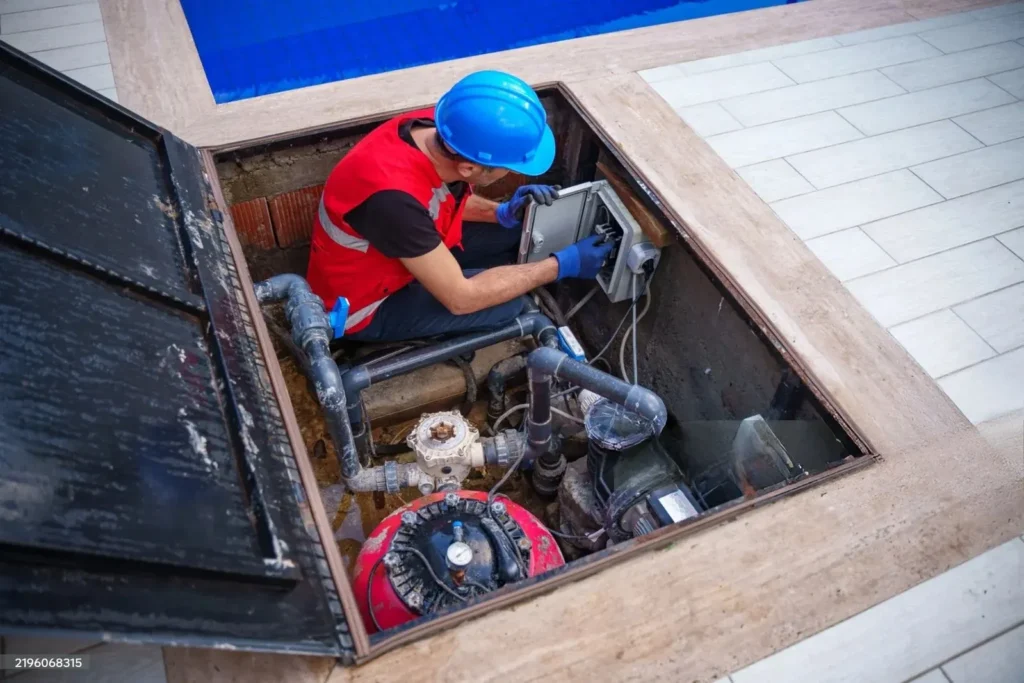
Houston pool filters need cleaning every 8 to 12 weeks during winter (December and January). Light use, lower water temperatures, and reduced biological load slow filter saturation. Skipping winter filter cleaning entirely is a mistake because of occasional freeze prep and lingering fall debris.
Houston winters are mild but not zero-load.
Winter filter cleaning notes
- December to January: Backwash or rinse every 8 to 12 weeks.
- Before a hard freeze: Run the pump continuously; freezing water in a clogged filter can crack the housing.
- After a hard freeze: Inspect all filter components for hairline cracks before restarting the pump.
- Pre-spring deep clean: Schedule a full filter clean in late February before pollen season begins.
The pre-spring filter clean is the most important of the year
A clean filter heading into March pollen season buys you the most usable life out of your media. Pools that skip the late-winter clean often need an emergency clean in April and another in May. Doing it once in late February replaces both.
When should I replace my pool filter instead of cleaning it?
Replace your pool filter media instead of cleaning it when cleanings stop restoring flow, the filter clogs in half the time it used to, or you see visible damage to cartridges, grids, or laterals. Cleaning a worn-out filter wastes time and lets debris bypass into the pool.
Replacement intervals are different from cleaning intervals.
When to replace each filter type
| Filter Type | Replace When | Typical Lifespan |
| Cartridge | Pleats are torn, pressure won’t reset after cleaning, or 12 to 15 deep cleans done | 2 to 4 years |
| Sand | Pool stays cloudy after backwash, sand has rounded smooth | 5 to 7 years |
| DE Grids | Grid fabric is torn, manifold is cracked, DE comes back into pool | 7 to 10 years |
The “half-life” replacement rule
If your filter used to clean every 8 weeks and now clogs in 4 weeks, the media has reached its half-life. Replacement is more cost-effective than continued cleaning at that point.
How to Build a Year-Round Filter Cleaning Schedule for Your Houston Pool
A reliable Houston filter cleaning schedule combines three things: a calendar baseline by filter type, PSI-based adjustments, and a few extra cleanings around pollen and hurricane season. The calendar gets you 80% of the way there. The PSI gauge and the weather get you the rest.
Write your clean baseline PSI on the filter housing with a permanent marker. Check it weekly. Clean when it climbs.
Your simple Houston filter schedule
- Set a calendar reminder for every 6 weeks (cartridge), every 5 weeks (sand), or every 5 weeks (DE).
- Check PSI weekly. Clean immediately if it crosses 8 to 10 above baseline.
- Add one extra clean in March or April for pollen season.
- Add one extra clean after any major storm during hurricane season.
- Schedule a professional deep clean every 3 to 4 months minimum.
When to call Houston Pool Cleaning Services
Houston Pool Cleaning Services provides professional filter cleaning across Houston, Katy, Cypress, Sugar Land, Pearland, The Woodlands, Spring, Missouri City, Pasadena, Richmond, and Friendswood. Every job includes documented PSI readings, certified technicians, and a 30-day clog-free guarantee. Call (713) 347-2715 for a free quote based on your specific filter type and pool conditions.
Frequently Asked Questions
Q: How often should you clean a pool filter in Houston?
A: Most Houston pool filters need professional cleaning every 3 to 4 months, with quick rinses or backwashes every 4 to 8 weeks during peak season. Cartridge filters clog fastest, followed by DE, then sand. The reliable trigger is a pressure gauge reading 8 to 10 PSI above the clean baseline.
Q: How often should a cartridge filter be cleaned during Houston pollen season?
A: Cartridge filters in Houston need cleaning every 4 weeks from February through May during pollen season. Live oak pollen counts can spike from 300 to over 3,000 grains per cubic meter in a single week. This is the heaviest filter load of the year for most Houston pools.
Q: Can I clean my pool filter too often?
A: Yes. Over-cleaning cartridge filters wears down the pleated fabric and shortens cartridge lifespan. Unicel recommends replacement after 12 to 15 cleanings, so cleaning every 2 weeks year-round burns through a cartridge in under a year. Follow the PSI rule instead of cleaning on a fixed weekly schedule.
Q: How often should I backwash a sand filter in Houston during summer?
A: Backwash your Houston sand filter every 4 to 6 weeks during summer or whenever pressure rises 8 to 10 PSI above baseline. Heavy storms, high bather load, or visible pollen can shorten the interval to every 3 weeks. Avoid backwashing within 12 hours of adding chemicals, since you’ll flush them out before they work.
Q: How often should I clean my DE filter and add fresh DE powder?
A: DE filters in Houston need backwashing and fresh DE powder every 4 to 8 weeks during peak season. The amount of powder varies by filter model, usually 4 to 8 pounds per recharge. A full grid teardown and tank cleaning should happen every 3 to 4 months on top of regular backwashing.
Q: Do Houston pool filters need cleaning in winter?
A: Yes, Houston pool filters still need cleaning in winter, just less often. Plan on backwashing or rinsing every 8 to 12 weeks during December and January. Schedule a full deep clean in late February before pollen season begins. Houston Pool Cleaning Services recommends this pre-spring clean as the most cost-effective filter service of the year.
Q: How often should I clean my filter after a Houston hurricane or tropical storm?
A: Clean the filter within 24 to 48 hours of any major storm. Heavy rain dilutes chlorine, raises phosphates, and pushes organic debris into the system at once. Acting within 48 hours prevents the algae bloom that otherwise establishes in 24 to 48 hours after a storm.
Q: What is the right pressure to clean a pool filter at?
A: Clean any pool filter when the pressure gauge rises 8 to 10 PSI above the clean baseline reading. Record the clean PSI reading immediately after each cleaning so you have an accurate reference point. Waiting longer than 10 PSI above baseline strains the pump and reduces actual filtration.
Q: Why does my pool filter get dirty so fast in Houston compared to other cities?
A: Houston filters load faster because of live oak pollen from February through May, year-round swim season, hurricane season debris from June through November, and hard mineral-rich tap water. These factors combined add roughly one extra filter cleaning per year compared to a dry inland city.