Replacing your pool filter is cheaper than cleaning it once the filter can no longer hold pressure after a clean, needs cleaning more than twice as often as it used to, or has visible structural damage. In Houston, most cartridge filters reach this point between years 3 and 5. The decision is not about price, it is about whether cleaning still works.
Why Does This Question Matter for Houston Pool Owners?
Most homeowners clean their filter on autopilot. They book a service, the tech cleans it, pressure drops, and everyone moves on. The problem is that cleaning a degraded filter wastes money and leaves your pool dirty.
Houston’s climate makes this worse. Pools here run 8–10 months a year. Storm season, heavy pollen, and hard water load the filter harder than almost any other U.S. market. A filter that lasts 5 years in Phoenix may last 3 in Houston. Knowing when to stop cleaning is a Houston-specific skill.
What Actually Happens When You Clean a Swimming Pool Filter?
Cleaning of pool filter removes surface debris, oils, and loose particles from the filter media. For a cartridge filter, you rinse the pleats and soak the element in a cleaning solution to pull out oils and minerals. For sand, you backwash to flush trapped debris. For DE, you backwash and re-coat the grids with fresh diatomaceous earth powder.
Each cleaning partially restores filtration. The key word is partially. Every cleaning cycle causes microscopic wear pleats to flatten slightly, fabric fibers separate, and the media becomes marginally less effective. After 12–15 cleanings, a cartridge filter cannot be restored to anything close to its original performance no matter how well you clean it.
That degradation is invisible on the surface. Your filter looks clean. But PSI climbs back faster, water clarity drops, and your pump works harder to push water through compromised media. You are paying to clean something already past its useful life.
How Do You Know When Cleaning Has Stopped Working for Your Houston Pool?
These are the specific signals. Two or more together means replace, not clean.
Pressure returns to high within one week of cleaning.
A healthy filter holds clean pressure for 6–12 weeks in normal conditions. Houston’s storm season may compress this to 3–4 weeks. But if PSI spikes within days of a full professional clean, the media is saturated beyond recovery.
You are cleaning twice as often as you used to.
Track your cleaning intervals from when the filter was new. When the time between cleanings drops to half of the original, the filter has reached its half-life. Manufacturers and industry experts both use this as the primary replacement signal. It does not matter how the filter looks, shortened intervals mean the media is spent.
Cloudy water that chemicals cannot fix.
If your water balance is correct but the pool stays murky, the filter is no longer catching fine particles. A functioning cartridge filters down to 10–20 microns. A degraded one passes them straight back into the pool. Shocking or adding a clarifier will not solve a filtration failure.
Visible damage on the cartridge element.
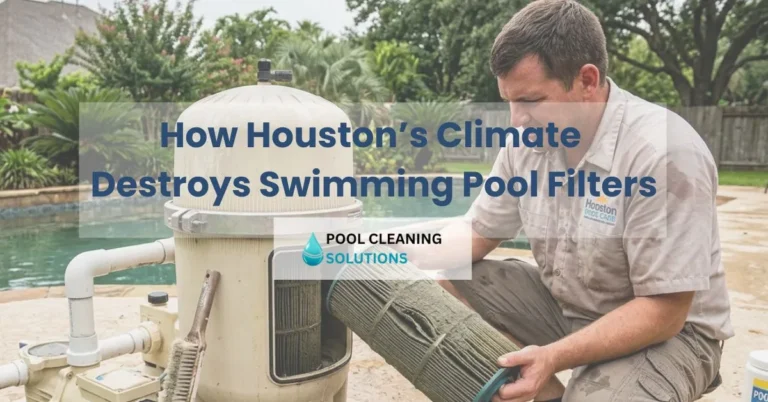
Fraying fabric between the pleats means fine debris bypasses the media entirely. Cracked or broken end caps mean water finds a path around the filter debris flows directly back into the pool. Broken bands alone are not a replacement trigger, but broken end caps always are.
The filter never fully recovers after an algae bloom or storm event.
If you clean the filter twice after a major bloom or storm and pressure still does not return to baseline, the media has absorbed more than it can release.
Is It the Cartridge or the Whole Unit That Needs Replacing?
This is the mistake most Houston homeowners make assuming replacement means replacing the entire system. In almost every case, it does not.
The housing tank, manifold, and fittings last 10–15 years with normal maintenance. What wears out is the media inside. For cartridge filters that is the pleated element. For sand filters that is the sand itself. For DE filters those are the internal grids.
Replace the full unit only when the housing has cracks, visible leaks at the valve or fittings, corrosion on the tank body, or a multiport valve that no longer seals after a rebuild. If none of those apply, swap the media and leave the housing.
A Pentair Clean and Clear 150 or Hayward C7030 cartridge element drops in without plumbing changes. A full system replacement for the same filter costs significantly more. Housing is almost never the problem.
Does Filter Type Change When You Should Replace?
Yes. Each filter type has a different replacement trigger.
Cartridge filters wear out through cleaning cycles, not age alone. The 12–15 cleaning rule from manufacturer Unicel is the most reliable threshold. In Houston at 3–4 cleanings per year, that means replacement every 3–5 years. Visual inspection of end caps, pleat fabric, and band condition confirms what the pressure gauge is telling you.
Sand filters do not wear out through cleaning because backwashing is gentle on the media. Sand replacement is triggered by channeling — when water finds a path through the sand bed rather than filtering through it. Signs include permanently elevated pressure even after backwashing, or water that turns cloudy immediately after backwashing instead of clearing. In Houston, expect sand replacement every 5–7 years.
DE filters need grid replacement when grids tear or when DE powder returns to the pool water during normal operation. If you see a white or gray film on the pool floor after running the filter, a grid is torn. Torn grids let DE pass directly into the pool instead of coating the filter surface. Grid replacement in Houston is typically every 5–10 years for a well-maintained system.
How Does Houston’s Climate Accelerate the Replacement Timeline?
Four Houston-specific factors push filters toward replacement faster than the national average.
Year-round pool use doubles filter hours.
A Houston pool runs 8–10 active months versus 4–5 in northern markets. All else equal, a Houston filter accumulates twice the operating hours in the same calendar year. Manufacturer lifespan ratings assume average use — in Houston you hit the upper end of those ranges faster.
Storm season creates debris surges.
After a tropical storm or heavy rain, leaves, dirt, grass, and sediment flood the pool. A single storm event can push a filter from clean to maximum pressure in 48 hours. Repeated storm loading compresses filter media in ways that normal swimming pool cleaning in houston cannot fully reverse.
Spring pollen is a cartridge filter’s worst enemy.
Houston’s March–May pollen season is severe. Fine pollen particles penetrate deep into cartridge pleats and resist removal even with soaking. Pool owners in The Woodlands, Katy, and Pearland report the most accelerated filter wear during this window.
Hard water deposits bind to the media permanently.
Houston’s municipal water has elevated calcium and mineral content. Scale binds to filter media and cannot be removed with a hose rinse alone; it requires an acid soak with diluted muriatic acid. Owners who skip this step progressively reduce their filter’s effective lifespan with every cleaning.